
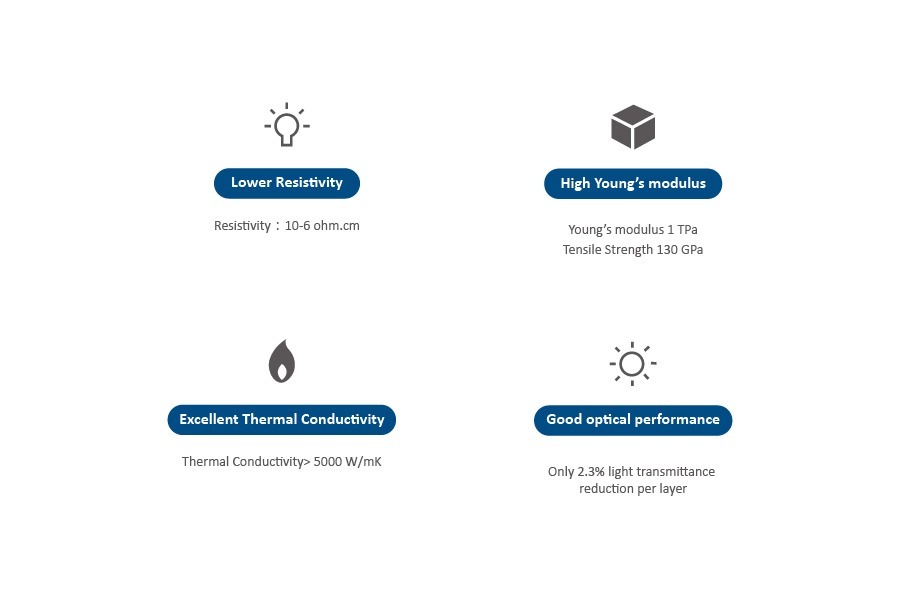
Lower Resistivity
Single-layer graphene at room temperature exhibits an exceptionally high electron mobility of 15,000 cm²/V·s, far surpassing that of silicon—the mainstream semiconductor substrate—which has a mobility of about 1,400 cm²/V·s. Its resistivity at room temperature is as low as 10⁻⁶ Ω·cm, outperforming even copper and silver, making it one of the lowest-resistivity materials known to date.
Graphene’s highly stable lattice structure enables outstanding electrical conductivity. When electrons travel within the graphene lattice, they experience minimal scattering from lattice defects, allowing charge carriers to move freely with very little interference. At room temperature, the strong interatomic interactions further suppress disturbances affecting electron motion.
With such exceptional properties, graphene is considered a promising candidate for the next generation of ultra-thin, high-performance electronic components and chips—advancements that may soon become a reality.
High Young's modulus
Graphene is currently known as one of the strongest materials on earth. The C-C bond length within graphene is only about 1.42 Å. When subjected to external force, the carbon atom plane can bend and deform to accommodate the stress without requiring atomic rearrangement, thereby maintaining structural stability.
This robust lattice structure gives graphene a hardness greater than diamond and a tensile strength over 100 times that of steel, while still offering excellent flexibility and ductility.
Excellent Thermal Conductivity
Graphene exhibits extremely high thermal conductivity. Raman spectroscopy analysis shows that, under relatively low laser excitation power, the redshift of the graphene G-band displays a linear relationship with sample temperature. Based on these measurements, graphene’s thermal conductivity at room temperature falls within the range of 4.84×10³ to 5.30×10³ W/m·K.
Thanks to this exceptional heat conduction capability, graphene is highly suitable for integration into electronic devices, where it can deliver outstanding heat-dissipation performance.
Good Optical Performance
Graphene possesses excellent optical properties. A single layer is extremely thin and highly transparent, with a light transmittance of up to 97.7% (corresponding to a light absorption of πα ≈ 2.3%).
Due to its high transmittance, light passing through graphene undergoes refraction and interference. By analyzing variations in optical contrast under a microscope, the number of graphene layers on a substrate can be accurately identified.